Start with the movement question
Before choosing a device, describe the decision in ordinary language. Are you checking whether a winger received enough high-speed running exposure? Comparing the demands of two small-sided games? Investigating the timing of a change of direction? These questions sound related, but they require different evidence. A position trace may help with the first two while offering an incomplete view of the third.
The useful distinction is between the physical signal and the metric calculated from it. An accelerometer produces measurements associated with acceleration at its location. A software platform may combine those measurements into a branded load score. That score is an interpretation built through processing choices, not an additional property directly measured inside the athlete.
Position systems describe a path
Global Navigation Satellite System, or GNSS, receivers estimate position using satellite signals. GPS, Galileo, GLONASS and BeiDou are different constellations that compatible receivers may use. A device’s headline sampling frequency does not, by itself, establish accuracy. Satellite geometry, signal obstruction, receiver design and processing can affect the resulting trace.
Stadium structures can obstruct or reflect signals. Sharp turns and brief bursts can expose limitations that are less apparent during steady straight-line running. Local positioning systems use venue-based infrastructure instead of relying on satellite signals for their position solution. They can be useful indoors, but anchor layout, calibration and the operating environment still matter. No method escapes the need for validation under the conditions in which it will be used.
Source notes: GPS.gov on positioning accuracy; the European Union Agency for the Space Programme on Galileo. These describe positioning systems, not a guarantee of accuracy for an individual sports unit.
Inertial sensors describe their own motion
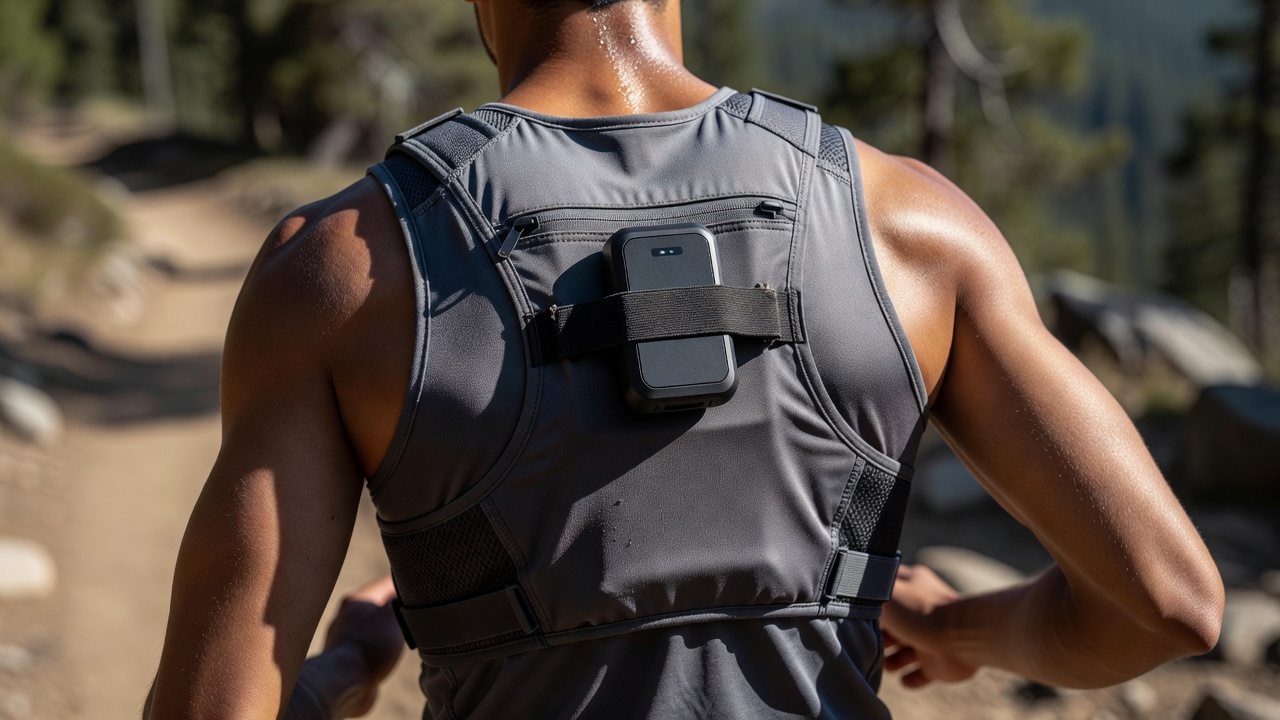
Inertial measurement units commonly combine accelerometers and gyroscopes, sometimes with magnetometers. They can capture rapid changes that are difficult to describe from position alone. However, the unit measures motion at its attachment point. An upper-back sensor is not a direct measurement of knee joint loading, foot contact force or tissue strain.
Placement, orientation and attachment stability change what the device experiences. A loose vest can introduce motion between the unit and the athlete. A sensor moved from the torso to a limb creates a different measurement problem, not merely another location for the same metric. Derived estimates of force or technique should be judged against suitable reference methods for that specific task.
Compare the method, not the label
“Distance”, “sprint” and “impact” can look reassuringly standard on a report. Their definitions may not be standard across suppliers. Check whether speed is derived from positional change or another signal, how missing samples are handled, which filters are applied, and how long a threshold must be exceeded before an event is counted. Identical labels can conceal materially different rules.
| Method | Useful observation | Important boundary |
|---|---|---|
| GNSS receiver | Outdoor path, distance and running speed estimates | Signal conditions and rapid directional changes affect quality |
| Local positioning | Venue-based movement traces, including indoor settings | Infrastructure, calibration and coverage require checking |
| Inertial unit | Acceleration and angular velocity at the sensor | Not a direct measure of whole-body or tissue loading |
| Optical tracking | Movement from camera observations without a worn receiver | Occlusion, identification and processing influence the output |
Check accuracy and repeatability separately
Accuracy concerns agreement with an appropriate reference. Repeatability concerns the consistency of repeated measurements under comparable conditions. A device can be consistent while retaining a systematic bias. For routine monitoring, both questions matter: is the value close enough for the decision, and can a change be distinguished from ordinary measurement variation?
Where practical, keep each athlete assigned to the same unit and maintain a record of firmware and software changes. Inspect suspicious traces rather than trusting a summary total. Compare a questionable acceleration event with session video or a coach’s observation before using it to reshape a training prescription.
Source note: FIFA’s EPTS programme provides a sport-specific framework for examining tracking systems. Read the scope and test conditions of any report; certification is not blanket validation of every derived metric.
Keep the conclusion smaller than the signal
A defensible statement might be: “The recorded high-speed exposure was lower than in comparable sessions, and the trace passed our quality checks.” A less defensible leap is: “The athlete is underprepared.” The second claim requires context about playing role, recent work, training objectives and physical capacity. Write the observation first, then list the alternative explanations.
Use the wearable to narrow a coaching question, not to close it prematurely. When the measurement does not resolve the question, a repeatable field test, video review or conversation may be the better next step. The most useful system is the one that supports the decision you actually need to make, with limitations the staff can explain.
What did that movement cost the athlete?
Pair external work with internal response, session purpose and the athlete’s account.
Read workload context ↗